
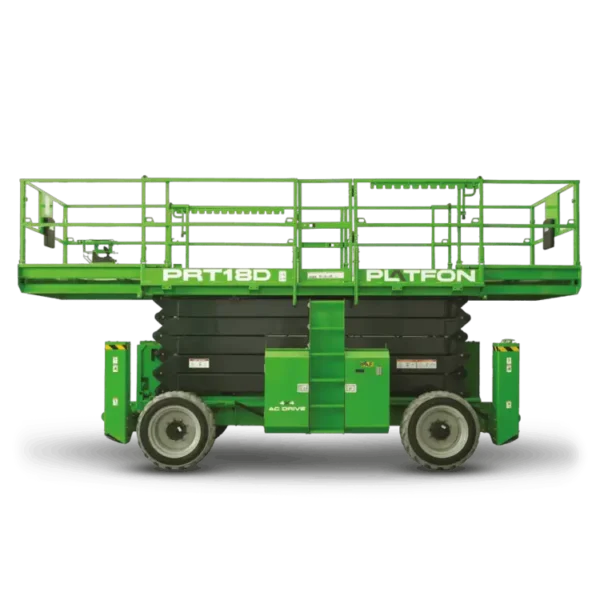
PRT18D Diesel Scissor Lift
- 17.95mMax. working height
- 15.95mMax. platform height
- 680kgLifting capacity
- 8,000kgMachine weight
Platfon offers one diesel scissor lift, the PRT18D, built for outdoor sites where the ground is uneven and charging is not practical. Here is what it does well, where its limits are and how it compares with the electric PRT18E.
| Model | Max. working height (m) | Max. platform height (m) | Lifting capacity (kg) | Machine weight (kg) | Max. persons |
|---|---|---|---|---|---|
| PRT18D Diesel Scissor Lift | 17.95 | 15.95 | 680 | 8,000 | 4 |
Diesel power makes sense when the work is outdoors, the ground is unfinished and there is no reliable supply for charging. Typical cases are new-build construction sites, industrial plants, storage yards, shipyards, energy and infrastructure projects, and any job where a machine has to work long days far from a socket.
The engine also brings limits. Exhaust gases rule out enclosed spaces, and engine noise can be a problem next to occupied buildings or at night. At 8,000 kg (17,637 lb), the machine needs firm ground or suitable pads under the outriggers, and a heavy-duty trailer to move between sites.
Platfon has one diesel model, so the choice within the range is simple. The real decision is usually between the PRT18D and its electric counterpart, the PRT18E Scissor Lift, which shares the same working height, capacity, platform size and weight. Ask for both in a single quote request if you are undecided.
Platfon lists five main features for the PRT18D. Each one answers a real problem on rough sites:
A rough terrain scissor lift is built for outdoor sites rather than smooth floors. It typically has four-wheel drive, larger tires and more ground clearance than a slab scissor lift, plus outriggers or a leveling system for uneven ground and a large platform for crews and materials. The PRT18D is Platfon's diesel rough-terrain model; the PRT14E and PRT18E are electric equivalents.
It should be avoided. Diesel engines emit exhaust gases and particulates that build up in enclosed spaces, and many site rules forbid them indoors. For work inside buildings, or for jobs that move between inside and outside, a battery-powered machine such as the PRT18E is the safer choice. The electric lift range covers indoor options at every height.
The power source. Both reach 17.95 m (58.9 ft) working height, carry 680 kg (1,500 lb) for up to four persons, weigh 8,000 kg (17,637 lb) and share the same 3.98 x 1.83 m (13.1 x 6.0 ft) platform and a near-identical equipment list. The PRT18D runs on diesel for remote outdoor sites; the PRT18E uses an AC electric drive for quieter, emission-free work.
The PRT18D weighs 8,000 kg (17,637 lb). That mass gives stability at height, but it also means the machine needs firm ground, load-spreading pads under the outriggers where the surface is soft, and a suitable low-loader or lowboy trailer for transport. Check bridge, ramp and slab limits on the route to every work position.
When the machine is parked on uneven ground, the outriggers extend and adjust automatically until the chassis is level, then hold it there while the platform rises. This saves the operator time and reduces the risk of setting up out of level. The operator must still check that every outrigger stands on firm ground or a suitable pad.
Up to four persons, within a total rated load of 680 kg (1,500 lb) that includes tools and materials. The platform measures 3.98 x 1.83 m (13.1 x 6.0 ft). Outdoor ratings and wind conditions can reduce the permitted occupancy, so always follow the capacity plate on the platform and the operator manual for the conditions on your site.
On top of the hydraulic and structural checks every scissor lift needs, a diesel machine requires engine servicing: oil and filter changes, air and fuel filter care, coolant checks and attention to the exhaust system. The intervals are set out in the operator and service manuals. Keep a record of each service for inspections and for resale.
Walk the route and each work position before the machine arrives. Look for trenches, backfilled ground, manhole covers, soft verges and overhead hazards such as power lines, and keep a safe distance from all of them.
On soft surfaces, plan load-spreading pads for the outriggers and agree in advance where the machine will park, refuel and turn.
Once the outriggers have leveled the chassis, the platform can be raised and the extension decks run out toward the work. The large deck lets a crew of up to four keep materials at hand, which cuts trips to the ground on cladding, glazing and steelwork.
Keep the total weight on the platform, including anything on the extensions, within the 680 kg (1,500 lb) rating, and spread heavy items rather than stacking them at one end.
Outdoor work at almost 18 m (59 ft) is exposed. If in doubt, measure the wind speed at platform height with a handheld anemometer, and stop work when it exceeds the rating on the data plate.
Do not carry large sheets or panels that act like sails, and lower the platform before a storm or lightning arrives.
Start every shift with the pre-use inspection in the manual: fluid levels, tires, outriggers, guardrails, gates, controls and emergency functions. A diesel machine adds fuel level, engine oil and a look at hoses and the exhaust.
Report defects immediately and keep the machine out of service until they are fixed. Operators must be trained and familiarized on the model, and someone on the ground must know how to lower the platform in an emergency.
On very soft or delicate ground, a crawler machine may be the better fit: see tracked scissor lifts. If the work sits behind an obstacle rather than directly above the machine, compare the articulating boom lifts.
For outdoor electric work at a lower height, the PRT14E Scissor Lift reaches 14.2 m (46.6 ft) with 365 kg (805 lb). The MEWP overview puts all six machine families side by side.
Tell us about the site, the ground and the working height you need. Platfon will confirm whether the PRT18D or the PRT18E suits the job and send a quote.