
PSP18 Tracked Boom Lift
- 17.7mMax. working height
- 15.7mMax. platform height
- 200kgLifting capacity
- 2,460kgMachine weight
The PSP18 is Platfon's tracked boom lift: a spider-type crawler platform that takes two people to 17.7 m (58.1 ft) working height, yet passes openings narrower than 1 m. Here is what it does well, where its limits lie and how to plan a set-up.
| Model | Max. working height (m) | Max. platform height (m) | Lifting capacity (kg) | Machine weight (kg) | Max. persons |
|---|---|---|---|---|---|
| PSP18 Tracked Boom Lift | 17.7 | 15.7 | 200 | 2,460 | 2 |
Put simply, it is a compact boom platform on tracks, designed to travel through narrow access and then set up to reach heights normally associated with much larger machines. Most spider-type machines work from splayed stabilizer legs, which give the category its name. Depending on the market, you will also hear crawler boom lift, compact crawler lift or tracked access platform.
You need one when the work is high but the way in is small: a rear garden reached through a side gate, a courtyard behind a historic building, a church nave, a shopping-center atrium, or a facade above a lawn or paving that must not be damaged. In those places a wheeled boom of similar height is usually too wide, too heavy or both.
The PSP18 Tracked Boom Lift is Platfon's only machine of this type. It combines a 17.7 m (58.1 ft) working height with a stowed width of 0.85 m (2.8 ft) and a weight of 2,460 kg (5,423 lb).
Unlike a wheeled boom that drives along the work, a spider-type machine normally works from a fixed position. The operator tracks it into place, deploys and levels the stabilizers, checks the ground under each foot and only then raises the boom. Moving to the next position means stowing the boom and repeating the set-up, so plan positions that each cover as much of the job as possible. The PSP18 operator's manual gives the exact sequence and limits.
A spider lift is a compact tracked boom platform that drives through narrow openings and then sets up, usually on stabilizer legs, to work at height. It is chosen where a wheeled boom would be too wide or too heavy. Platfon's PSP18 is a spider-type machine with 17.7 m (58.1 ft) working height, a 0.85 m (2.8 ft) stowed width and rubber tracks.
The PSP18 is 0.85 m (2.8 ft, about 33 in) wide when stowed, 2.0 m (6.6 ft) high and 5.30 m (17.4 ft) long. That lets it pass many garden gates, single doorways and side passages. Measure the clear width at the narrowest point and check corners, steps and slopes on the route, because the length of the machine matters as much as its width when turning.
Weights vary widely with height class and design. The Platfon PSP18 weighs 2,460 kg (5,423 lb), which is light for a machine that works at up to 17.7 m (58.1 ft); Platfon's wheeled PB18 articulating boom reaches the same height at 8,000 kg (17,637 lb). Lower weight eases transport and floor loading, but the ground under each stabilizer still needs checking.
Yes, an electric tracked machine is a common choice for atriums, churches, theaters and shopping centers with limited door access. The PSP18 is electric, so there are no exhaust fumes at the point of use. Check floor capacity with the building owner, protect delicate finishes under the tracks and stabilizer feet, and confirm the route through the building before the machine arrives.
A tracked scissor lift raises a large deck straight up: the PCS14 Tracked Scissor Lift, for example, carries 318 kg (701 lb) to 13.8 m (45.3 ft) of working height and suits work directly above the machine. A spider-type machine has a boom, so it reaches higher and up and over obstacles, but with a smaller platform and less capacity: 200 kg (441 lb) on the PSP18.
On most spider-type machines, no. They are designed to travel with the boom stowed and to work from a levelled, stabilized set-up. To move, the operator stows the boom, retracts the stabilizers and tracks to the next position. Check the PSP18 operator's manual for its exact travel and set-up rules, including slope limits while traveling.
Crawler booms are chosen for tree care and pruning, facade cleaning and repair, gutter and roof-edge work, glazing maintenance, restoration of historic buildings and interior work in atriums and halls. The common factor is restricted access combined with height. If the ground is open and firm and the access wide, a wheeled boom or scissor is usually quicker to position.
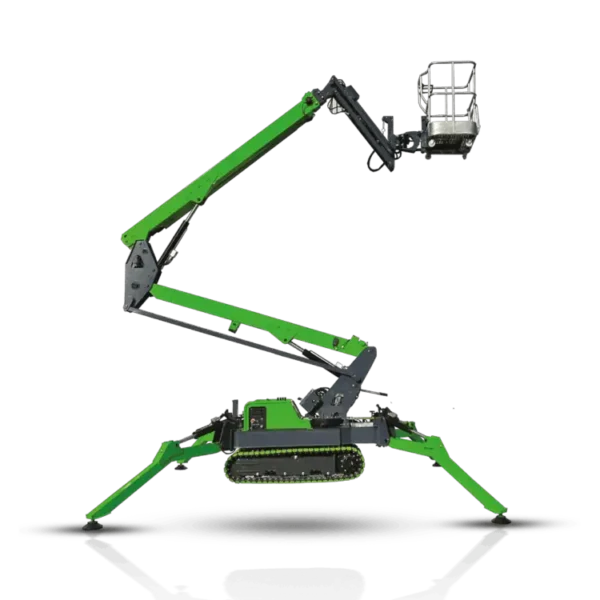
Rubber tracks spread the machine's weight while it travels, which helps on lawns and block paving that would rut under wheels. Use ground protection mats on soft or finished surfaces, and keep clear of septic tanks, drains, cellars and recently dug trenches.
For tree work, plan for falling debris: set an exclusion zone below the platform, keep the boom clear of branches under tension and never attach ropes or rigging to the platform unless the manual expressly allows it.
On heritage buildings, the narrow chassis and modest weight let the machine set up close to the wall without scaffolding, which suits inspections, pointing, cleaning and small repairs. The 1.10 x 0.70 m platform takes two people with hand tools; heavy stone or glass needs lifting equipment designed for loads.
Agree set-up positions with the site owner in advance, especially where paving, steps or planted areas are protected.
Indoors, the questions are floor strength, finishes and the route. Ask for floor loading data, especially over basements or suspended slabs, because the stabilizer feet concentrate load once the machine is set up. Lay boards or mats where the floor is polished stone, timber or tile.
Being electric, the PSP18 produces no exhaust fumes at the point of use, which makes work in occupied buildings easier to approve. Barrier off the area below the platform so that nobody walks beneath it.
The PB18 Articulating Boom Lift reaches the same 17.7 m (58.1 ft) working height but is 1.90 m (6.2 ft) wide and weighs 8,000 kg (17,637 lb). It needs no stabilizer set-up, so on open, firm sites it moves between work positions faster.
The PSP18 is the choice when access width, floor loading or ground protection rules out the wheeled machine. For lower vertical work on soft ground, the tracked scissor lifts are another option, and the articulating boom lifts page covers the full PB range.
Operators should hold recognized training for the machine category and be familiarized with the PSP18 before first use. As on other boom-type machines, operators normally wear a full-body harness clipped to the platform anchor point with a short restraint lanyard; the manual and site rules decide the details.
Before raising the boom, check wind speed against the limit on the data plate and look up for power lines, branches and structures. Listed safety equipment includes emergency stop, emergency lowering, overload protection and a descent alarm, and a trained person on the ground must know the emergency lowering procedure.
Send the access width and height, the working height you need, the ground or floor type, and whether the work is indoors, outdoors or both. Platfon can then confirm whether the PSP18 suits the job. Products are CE-certified; certificates and catalogs are available on the Documents page.
To see how this machine fits alongside scissor, mast and wheeled boom families, visit our overview of aerial work platforms, or read the price guide for the factors that shape a quote.
Send us the narrowest access width, the height of the work and the ground conditions, and we will prepare a quote for the PSP18.